Execution Blueprints
Business Process Blueprints
Define how the business will work - before you build.
SplitLogiX turns business objectives into an agreed operating model: the processes to perform, the decisions to make, the responsibilities to assign, and the technology needed to support the work.
When everyone understands the goal - but not the same way of getting there
A blueprint is useful when you are preparing for a new system, changing the operating model, growing across locations, or trying to make inconsistent processes repeatable.
Different versions of the process
Departments, locations, and shifts interpret responsibilities and handoffs differently.
Requirements built on assumptions
A software demonstration looks right, but the difficult business scenarios remain undefined.
Knowledge that is hard to transfer
Critical steps live in a few people's heads, while procedures no longer match the work.
Change without a clear boundary
Teams cannot distinguish what should stay, what must change, and what can wait.
More than a flowchart
A Business Process Blueprint joins process logic, ownership, business rules, information, and implementation requirements into one approved reference. A diagram shows the sequence. The blueprint also explains the purpose, the decisions, the controls, and the expected outcome.
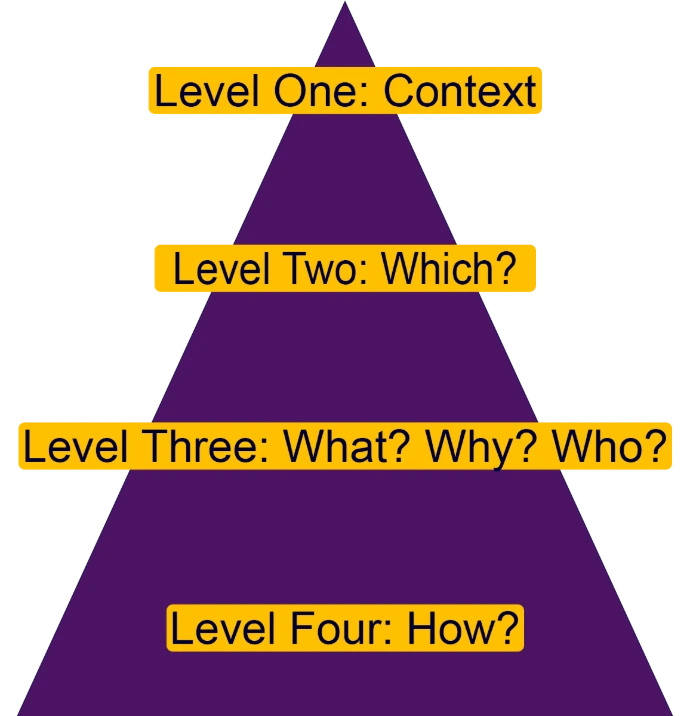
Four levels. One connected operating model.
Different decisions need different levels of detail. We start with the business context and work down to the execution detail required by the engagement.
Context
The business objective, operating boundaries, entities, functions, and external relationships.
Which?
Identify process groups in scope: what is new, what changes, and how the work fits together.
What? Why? Who?
The business logic: triggers, outcomes, responsibilities, and decisions independent of software.
How?
The execution detail: task sequence, system transactions, and role-specific guidance.
The right depth for the decision
A design engagement can conclude with approved Levels 1-3 and the requirements for the next stage. Level 4 work instructions and system-specific detail can be developed later, once the solution is sufficiently defined.

What your team receives
Agreed scope and process structure
Business objectives, operating boundaries, process inventory, and priorities for new or changed work.
Defined future operating model
Process flows with ownership, decision logic, business rules, and the information required at each handoff.
A bridge into implementation
Requirements for systems and integrations, organizational impacts, and a sequenced view of next steps.
An approved reference
Named process owners, documented decisions, and a practical way to maintain it as the business changes.
Where included in scope, we extend into detailed work instructions and training material. Deliverables are confirmed before work begins.
A process-led path from objective to execution
We work with the people who own the outcome and the people who perform the work. SplitLogiX structures the design, challenges assumptions, and develops the detail.
1
Understand
Establish the business objective, constraints, and measures of success.
2
Design
Define future flow, including normal paths and exceptions.
3
Align
Clarify ownership, approvals, and changing roles.
4
Select
Translate approved logic into system requirements.
5
Enable
Validate design with realistic scenarios.

Decisions are part of the deliverable
Workshops should resolve choices, not simply collect opinions. We make the options and tradeoffs visible, record the selected approach, and assign ownership to unresolved items.
The result is a shared basis for action: what has been agreed, what remains open, and what must be true before the next stage begins.
Discuss Your BlueprintMake the difficult handoffs visible
Illustrative example: a service request
The blueprint makes the operating decisions underneath labels visible. This level of clarity ensures everyone understands how the process actually functions.
| Design question | Illustrative process decision |
|---|---|
| What starts the work? | A requester submits information needed to assess a service need. |
| Who owns the outcome? | A designated service owner remains accountable. |
| What must be decided? | Urgency, approval needs, resource assignment. |
| Handoffs and exceptions | Incomplete info returns; escalation paths are followed. |
| Information flow | Status, approvals, evidence, and cost information. |
| Proof of completion | Record is complete and results are reliable. |
Keep the design useful after sign-off
A blueprint should remain a usable reference as the operation evolves. Process models can be maintained in a digital repository with clear ownership and a controlled path for updates.
AI-assisted preparation. Human-owned decisions.
We use AI to help structure information and accelerate drafting. Experienced consultants still validate facts and approve the design. AI does not replace accountability.
Start at the scale your business needs
A focused process
Start with one difficult workflow or bottleneck. Define boundaries and handoffs without documenting the entire organization.
A broader blueprint
Create a connected view across functions or entities. Establish the overall structure and focus work where it supports the objective.
Bridge to implementation
Use the blueprint to prepare for system selection or new operating environments. Extend into detailed system-specific support.
"We consider our partnership with them a strategic asset."
Frequently asked questions
Is an Execution Blueprint different from a Business Process Blueprint?
Execution Blueprints is the name of this service family. The Business Process Blueprint is the structured operating model at its center.
How is this different from a process map or an SOP?
The blueprint connects these details to the broader operating model, including ownership, rules, dependencies, and system requirements.
Do we need to buy new software?
No. A blueprint can improve the use of existing systems. Where tech must change, it provides the requirements for evaluation.
Does every engagement include all four levels?
No. Depth depends on the stage. We can define Levels 1-3, with Level 4 developed later under an agreed scope.
Give your next business decision a clear operating foundation
Tell us what needs to change, where teams or systems are misaligned, and what the business needs to achieve.